


They say you should never judge a book by its cover, but consumers do it every day. In-store, labels provide a promise of the product that lies within, helping brands stand out among the ever-increasing clutter, and enticing consumers with colour, texture, and especially in the wine business, a whole lot of shine.
Hot stamping offers an ideal means of expressing tradition or modernity, and for indicating the particular characteristics of a wine. Classic designs in gold, silver or copper, for example, underscore the tradition and experience of renowned wineries and promise exceptional cellar treasures. Bold metallic colours like pink or turquoise and glittery holographic designs suggest a young product line or fruity fresh wines.
“Labels incorporating metallic foil are becoming increasingly popular in the local wine industry, not only because they help brands stand out on shelf, but also because they convey an impression of quality,” says Sarah Sonnenberg, MD at Synchron.

When it comes to creating a high-quality metallic finish, hot stamping is the technology of choice. The technique involves using a heated stamping die, pressure and heat allowing the metallised layer to become exceptionally smooth, giving it a unique metallic gloss, and an unparalleled high-quality appearance.
In addition, hot stamping provides designers with the unique ability to stimulate both the visual and tactile senses in the consumer.
The state-of-the-art stamping die technologies from Hinderer + Mühlich, a member of the Kurz Group, offer a broad range of design possibilities. Besides flat stampings, it is also possible to produce a wide variety of relief and structured stampings, including single-level reliefs, multi-level sculpture-type reliefs, depressions or debossing, micro-embossing and even so-called NanoEmbossing, which can be used to generate extremely fine structures, gradients and matt finishes, or photographic and flip-flop effects.

South African market representative Phumzile Dlamini, foils product & marketing manager at Synchron, reports that KPS Slim Patent Pending has been successfully introduced to the local market. ‘This product is fast becoming the preferred cold transfer option thanks to an ongoing educational process between Synchron, printers/converters and brand owners. It allows printers/converters to ensure that they are sustainably contributing to the environment using this process instead of metallised board and paper,’ she enthuses. ‘Collectively, we are also finding new embellishment opportunities in the sheet-fed offset printing market every time we introduce and trial the KPS Slim Patent Pending.’
Related Posts
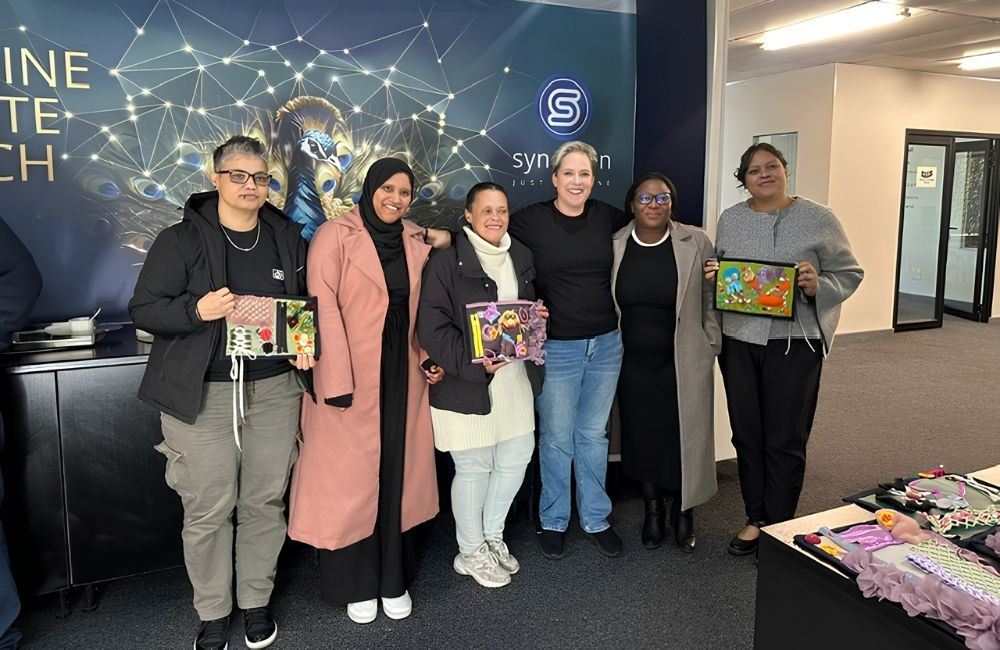
For Mandela Day, the Synchron team turned familiar fabrics into thoughtfully designed sensory blankets, combining creativity, expert guidance and community care. Together with donations of food and clothing, the handmade blankets supported three local organisations and showed how everyday resources can make a meaningful difference.

Mpact laboratory testing provides encouraging evidence for brands considering decorative transfer foil on fibre-based packaging. Three KURZ hot- and cold-transfer foil samples achieved exceptionally high fibre yields and were assessed as suitable for standard-mill recycling, supporting more informed and responsible packaging design.

Once upon a time, a truck curtain was mainly expected to keep cargo covered, protected from the weather and easy to access during loading and unloading. That has changed…
