


Hot stamping or foil printing is one of the most cost-effective decoration techniques for branding or customising a packaging component. Hot stamping produces a luxurious appearance and brings a strong value-add to a glass product.
Direct printing on glass is a rising business. More and more, ceramic glass pastes for oven baking are being replaced by organic silk screen inks, notably UV curing systems. Ultraviolet curing (commonly known as UV curing) is a photochemical process in which high-intensity ultraviolet light is used to instantly cure or “dry” inks, coatings or adhesives. UV formulations are liquid monomers and oligomers mixed with a small percent of photoinitiators, and then exposed to UV energy.

Among other things, organic inks are based on plant-based binder systems. This makes them more easily bio-degradable than classic mineral inks, and therefore better for the environment and printing facilities. The benefits of organic inks consist in a considerably lower energy input, higher colour stability and higher gloss level. Along with that, there is an increasing demand for high-quality metallic finishing by means of hot stamping, as an alternative to those very expensive genuine metals or optically less attractive metallic inks.
LUXOR®/ALUFIN® SGU made by KURZ is the new finishing solution that is hot stamped onto glass surfaces by means of a UV silk screen adhesive. At first, the requested design is applied with a silk screen adhesive onto the glass body, and UV cured. Subsequently, LUXOR®/ALUFIN® SGU is applied onto the adhesive in roll-on stamping by means of a heated silicone wheel. Up-and down stampings by means of form dies onto full-surface dip or spray coated glass bodies are possible, yet less common with glass decorations, due to the relatively high substrate tolerances.

The main characteristics of LUXOR®/ALUFIN® SGU:
• good adhesion on UV silk screen inks commonly used for glass decoration
• very high gloss level, even after post-curing
• extremely clean definition
• high temperature resistance
• high resistance against scratches and abrasion
• high chemical resistances.
EPR and sustainability
Synchron confirms that sustainability plays a huge role in the glass decorating sector and that brands continue moving towards glass and aluminium, as well as hybrid solutions. Kurz has been focusing on sustainable solutions for decades, which is why we ensure that no foil is transferred during our embossing transfer process and that packaging finished with our solutions remains recyclable as only the thinnest decorative layers (in the nano range) are transferred. The PET film, which serves as a carrier for the coating layers, is peeled off during the transfer process and can be collected and recycled in Germany through Kurz’s Recosys® programme to create high-quality injection moulding material.

Maximising efficiencies and adaptability
Synchron emphasises that to take advantage of new opportunities as an embellishment material and technology supplier during 2022/2023, they have to show flexibility in terms of deliverables, and in the capacity of its deliveries by learning to cope with market uncertainty and ensuring the availability of products. ‘Consumer behaviour has become unpredictable and we need to cope with situations where demand increases by rebuilding stocks in our warehouses,,’ concludes sales and marketing manager, Phumzile Dlamini.
© Synchron Fabrics & Foils, December 2024
Related Posts
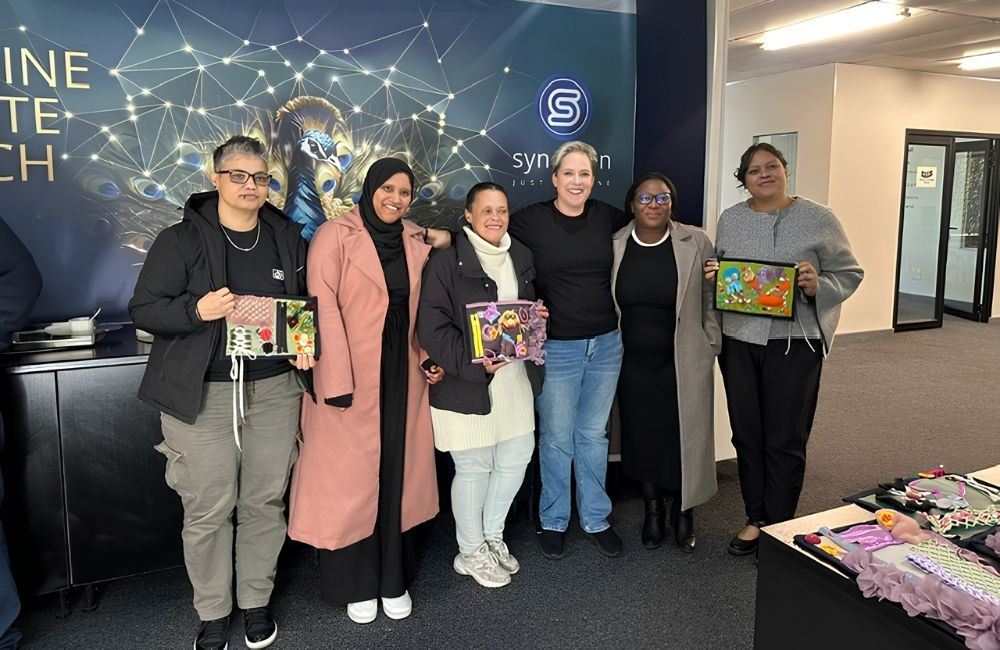
For Mandela Day, the Synchron team turned familiar fabrics into thoughtfully designed sensory blankets, combining creativity, expert guidance and community care. Together with donations of food and clothing, the handmade blankets supported three local organisations and showed how everyday resources can make a meaningful difference.

Mpact laboratory testing provides encouraging evidence for brands considering decorative transfer foil on fibre-based packaging. Three KURZ hot- and cold-transfer foil samples achieved exceptionally high fibre yields and were assessed as suitable for standard-mill recycling, supporting more informed and responsible packaging design.

Once upon a time, a truck curtain was mainly expected to keep cargo covered, protected from the weather and easy to access during loading and unloading. That has changed…
