


Healthcare environments demand materials that do more than perform – they must actively protect. A decade-long installation at Christiaan Barnard Memorial Hospital now provides rare, real-world validation of antimicrobial fabric performance.
In a high-stakes clinical environment like a General Intensive Care Unit (ICU), surface contamination is a critical vector for the transmission of healthcare-associated infections (HAIs). Traditional porous window treatments are often overlooked reservoirs for pathogens, moisture, and dust.
When Netcare’s Christiaan Barnard Memorial Hospital moved to its Cape Town CBD facility in 2016, it addressed this risk by installing Soltis 99 blinds powered by Agivir™ technology. A decade later, internal testing has confirmed that these surfaces are still as effective today as they were on day one.
The Challenge: Beyond aesthetic window coverings
ICUs manage complex, high-acuity, and often immunocompromised patients. Traditional woven fabrics are difficult to clean and can harbour microorganisms in surface pits. The hospital needed a solution that offered:
- Active pathogen elimination: A surface that doesn’t just hold bacteria but actively kills them.
- Durability: The ability to withstand hospital-grade disinfectants for years without degrading.
- Patient comfort: Superior thermal and light control to aid recovery.
The 10-year test
Recently, Netcare Head Office conducted internal verification tests on the original 2016 installations to see if the Agivir™ treatment, an antiviral and antibacterial coating, was still active.
The findings were definitive: The product continues to perform according to its original specifications, maintaining its ability to eliminate >99.9% of viruses and bacteria, including human Coronavirus 229E.

Technical expertise: Why Soltis 99 outperforms
The longevity and efficacy of the blinds are rooted in Serge Ferrari’s specialised manufacturing technologies:
- Précontraint® technology: This world-patented process keeps the fabric under bi-axial tension during coating. This results in an extremely flat, smooth surface that lacks the porous “weave” where pathogens typically accumulate.
- Agivir™ Antiviral surface: This certified treatment is effective against a broad spectrum of pathogens (Gram+ and Gram- bacteria) and has been validated under ISO 21702 for virucidal properties.
- Thermal efficiency (LowE): The Soltis 99 LowE variant acts as a thermal barrier, reducing air conditioning needs by up to 40%. This is critical in ICUs to reduce the circulation of HVAC-mediated airborne pathogens.
- Blackout for clinical precision: The Opaque Alu variant provides Class 4 (100% blackout) conditions necessary for specific medical procedures and patient rest cycles, while retaining the same antimicrobial surface.Lightweight construction with structural benefits
A model for sustainable healthcare procurement
The 10-year performance at Christiaan Barnard Hospital demonstrates a significant return on investment:
- Zero replacement cycles: While standard fabrics may require 10 to 20 replacement cycles over a decade due to wear or contamination, the Soltis 99 blinds remained in situ and fully functional.
- Certified safety: Soltis 99 holds the highest international fire ratings, including Euroclass B-s2, d0 and ASTM E84 Class A, meeting strict South African hospital safety standards.
Data from the Christiaan Barnard Memorial Hospital demonstrate that specialised composite fabrics are a vital component of a modern infection control strategy. By choosing Soltis 99, healthcare facilities can ensure long-term patient safety, operational efficiency, and verifiable clinical results.
Is your facility still using traditional fabric blinds in high-risk areas? Contact Synchron to review the latest Agivir™ clinical data or to request a substrate trial for your next ward upgrade.
Related Posts
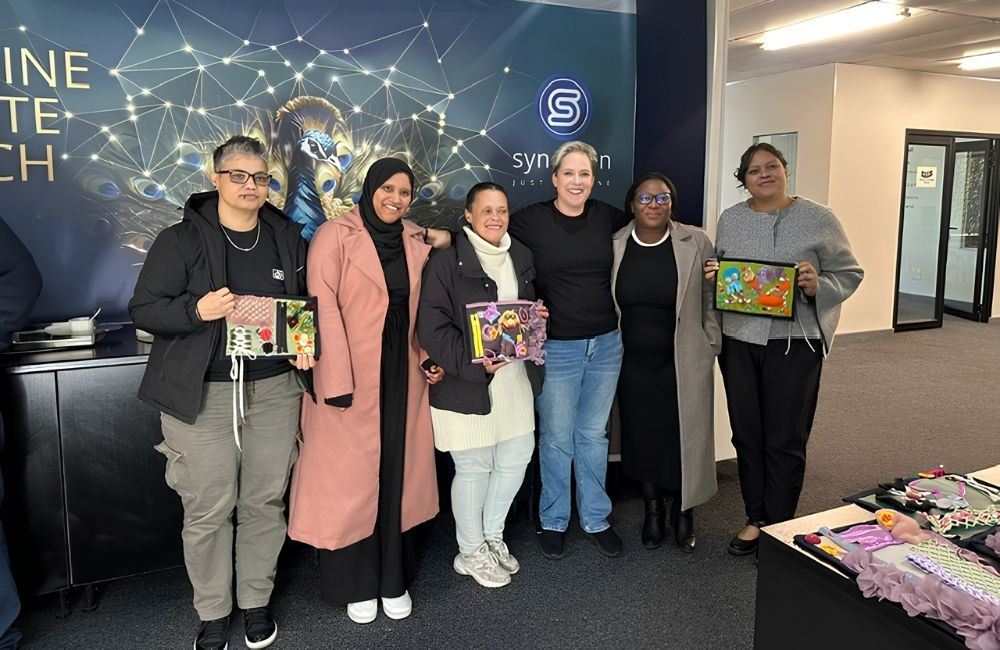
For Mandela Day, the Synchron team turned familiar fabrics into thoughtfully designed sensory blankets, combining creativity, expert guidance and community care. Together with donations of food and clothing, the handmade blankets supported three local organisations and showed how everyday resources can make a meaningful difference.

Mpact laboratory testing provides encouraging evidence for brands considering decorative transfer foil on fibre-based packaging. Three KURZ hot- and cold-transfer foil samples achieved exceptionally high fibre yields and were assessed as suitable for standard-mill recycling, supporting more informed and responsible packaging design.

Once upon a time, a truck curtain was mainly expected to keep cargo covered, protected from the weather and easy to access during loading and unloading. That has changed…
